Using the example of the multi-professional and diverse consulting landscape in the field of conspiracy thinking
By Till Wagner (Violence Prevention Network)
This article was first published in German in: Interventionen #19, 2025 by Violence Prevention Network
Introduction
The experiences gained in establishing the network of counselling centres in the context of “Verweisberatung Verschwörungsdenken (referral counselling network for the prevention of conspiracy thinking)” offer insights and findings for general networking in the field of extremism prevention and counselling work.
In this context, it is important to consider the systemic working conditions that stand in the way of field-wide networking, such as resource scarcity, communication deficits and competitive dynamics. The key development steps in establishing a network that respond to these working conditions make it possible to draw lessons and define conditions for success and best practice recommendations. Through open and transparent communication, the continuous provision of opportunities for participation and reflection on systemic barriers, the needs of the organisational landscape can be addressed in such a way that sustainable networking structures can emerge. The “Verweisberatungsnetzwerk Verschwörungsdenken (referral counselling network for the prevention of conspiracy thinking)” can serve as a model for the establishment of comparable networks in the future.
1. Cooperation instead of coexistence: networking in the context of prevention and counselling work
The German model of extremism prevention comprises a variety of measures and actors who relate to each other in their respective work and are expected to cooperate:
1.) Information and education actors carry out key work in primary prevention in local, regional or nationwide projects, both offline and online, by providing political and historical education on anti-democratic, authoritarian and extremist ideologies and the groups associated with them.
2.) Counselling services with different educational and thematic specialisations and different regional responsibilities work within the framework of secondary and tertiary prevention, primarily using counselling methods and with the aim of prevention and distancing from persons at risk of radicalisation or already radicalised.
The prevention landscape, which is structured according to different tasks and thematic areas, consists of many individual actors and is therefore highly divergent. It also differs in terms of sponsorship: civil society, church and state actors work alongside and with each other in the field. In addition, there are varying degrees of cooperation with state security and law enforcement agencies in the context of hazard prevention and tertiary prevention.
This diversity and differentiation, which is generally present in the prevention landscape, was one of the starting points for a project implemented by a consortium of organisations – consisting of the Amadeu Antonio Foundation, modus | zad – Centre for Applied Deradicalisation Research and Violence Prevention Network – since March 2024. The field of counselling relevant to the project on the topics of conspiracy ideologies and conspiracy thinking is, on the one hand, younger and thus less extensive in its specialised form than, for example, the fields of counselling on „right-wing extremism“ or „Islamism“, but on the other hand, it is opening up more to other areas such as worldview or sect counselling and advising on esoteric and health topics, which further emphasises the aspect of diversity and differentiation.
This nature has many advantages:
- The thematic, task-related differentiation of the field, which is reflected in different models of sponsorship, enables target group-sensitive counselling, information and education, ensures a variety of competing approaches and enables low-threshold accessibility for local target groups.
- Furthermore, especially in the field of counselling on conspiracy ideologies and conspiracy thinking, centralisation of the landscape, even under state or security authority sponsorship, seems inadvisable: The target group of conspiracy believers themselves, which is also addressed by some advising services, often feels a strong distrust of state actors due to their own worldview – in some cases, the hurdle to actively seeking help is lower for civil society organisations.
- Even for the larger target group of conspiracy theorists‘ family, social or professional circles, the breadth of available services is an advantage and reduces the fear of possible stigmatisation, which can prevent people from seeking counselling or information.
However, the differentiation of the field also poses problems and challenges for effective counselling, information and prevention work:
- Developments in the highly dynamic field of counselling may be perceived only belatedly and asynchronously by the various actors.
- Experiences regarding the effectiveness of advising or educational approaches are not shared sufficiently, which means that potential synergies remain untapped.
- Cross-project exchange of expertise remains at a low level, as some of the existing actors are unaware of each other.
- Even more important to emphasise is the perspective of those seeking advice: the landscape, which is already confusing for experienced professionals, quickly becomes impenetrable and thus overwhelming for those seeking advice. Where can I find counselling, where can I find information? Which counselling service is right for my needs? Is my concern „serious“ enough to warrant contacting them? Questions like these stand in the way of accessing professional help and are also the downside of the welcome differentiation and diversity.
They also highlight the relevance of one of the central objectives of the aforementioned project for the „further development“ of the counselling field: the networking of the field through the establishment of a nationwide referral service on the subject of conspiracy ideologies and conspiracy thinking, which aims to match those seeking advice with the appropriate counselling or information services depending on their concerns and region, and which has been active since the end of February 2025 at www.beratungskompass-verschwoerungsdenken.de. This objective goes beyond an already existing, active and very productive specialist network in the form of the „Federal Network on Conspiracy Narratives“, primarily through the referral service component and an even broader networking approach. In the context of P/CVE and counselling work, targeted and effective networking ideally ensures that the expertise available in specific areas is pooled and that counselling and educational work is gradually professionalised through mutual knowledge exchange and, above all, becomes more accessible to those seeking advice. In this respect, it can be understood as a transformative step from isolated, but difficult to access and unconnected expertise and experience to a collaborative counselling field.
2. Resource scarcity and internal logic: obstacles to sustainable networking
The form of differentiation and diversity in extremism prevention described above, together with the current models of financing for the relevant actors, represents the central obstacle to sustainable networking: in most cases, actors in the field of P/CVE are subject to the logic of state project funding. Own funds, donations or non-governmental funding sources normally account for only an insignificant portion of the funds necessary to maintain operations.
On the one hand, this means that the services in question have to operate in an extremely resource-efficient manner, and in some cases precariously. The often limited number of positions is frequently barely sufficient to cope with the core work – i. e. the implementation of information, counselling or education projects – and the associated administrative work. There is often a lack of time and resources for additional tasks such as public relations, quality assurance and evaluation, or networking in the field. On the other hand, as a result of the resource scarcity described above, employment contracts are usually temporary and staff turnover among individual actors is high. One result of this structural feature is discontinuity in interpersonal networking between actors – without at least a soft institutional anchoring in the form of established networks, networking efforts often remain sporadic or short-lived.
The cause of the scarcity of resources is also linked to the obstacle of widespread competition and self-interest, which is understandable from the perspective of individual actors and sometimes even necessary from an internal perspective, but which is problematic for the prevention landscape as a whole: various actors compete for limited funding with applications that are as original as possible. Although the entire field, often with strong identification at the individual level, pursues the same goals, individual actors are forced to try to stand out in order to be in a better position in the competition for resources. These competitive and self-serving logics, which are due to systemic circumstances, directly or indirectly hinder cross-organisational networking efforts, as they aim to benefit the respective project or actor. The aforementioned project for the „further development“ of the field on the topics of conspiracy ideologies and conspiracy thinking was also confronted with these obstacles to the desired networking.
3. In practice: connecting the counselling landscape for the Conspiracy Thinking Counselling Compass (Beratungskompass Verschwörungsdenken)
As part of the aforementioned project, connecting the counselling landscape took place in several steps, beginning with a scientific inventory of the field, which was carried out by a member of the association, modus | zad.
- In retrospect, it should be noted that the objective overview of the information, counselling and prevention landscape thus created was the first important step and the necessary basis for sustainable networking: particularly in the field of conspiracy ideologies and conspiracy thinking, the terminology used and the approaches represented vary. A collection of potential actors relevant for networking based solely on keyword searches, easily found self-descriptions or existing networks in the field would have been insufficient, as, for example, individual counselling services specialising in the phenomena of right-wing extremism or Islamism, as well as counselling services on sects and the churches‘ representatives for world views, also provide advice on the subject area, but do not necessarily communicate this aggressively to the outside world. The survey, conducted according to defined parameters such as the phenomenon area served, sponsorship or target group, provided the basis for a comprehensive approach to the field.
- The second key step for effective networking was to incorporate existing networking structures, in particular the „Bundesnetzwerk Verschwörungserzählungen (Federal Network on Conspiracy Narratives)“, which, as an organically grown structure in the field, already included some of the actors to be involved and had effectively networked them. It quickly became clear that a newly implemented network should only complement existing network structures and under no circumstances replace them – any other approach would have run counter to the objective pursued.
When individual actors and existing networks were approached against this backdrop, the obstacles outlined in the previous chapter quickly became apparent: although most actors were fundamentally positive about the project of professionalisation and improved cooperation, concerns were quickly raised in the example described that the planned networking work could not be managed against the backdrop of scarce resources.
Implicitly, acting according to one’s own logic often seemed to cause scepticism towards a centrally controlled and state-commissioned networking project. From the author’s point of view, various lines of thought have been effective here, which must also be reflected upon in other contexts when establishing network structures: Does centrally organised networking threaten my service or project by potentially influencing future funding? Is there a risk of external interference with methods developed and proven in my service or project? Will my service or project be subject to new external regulations or rules as a result of participating in the network?
In the networking work carried out as part of the project described, which also formed the basis for setting up the associated referral advisory structure, these obstacles were countered with communication that was as transparent as possible, a resource-efficient approach and a variety of trust-building exchange formats.
It is very important to communicate the project goals and steps to the actors in the field from the outset in order to reduce existing scepticism or reservations. To this end, targeted mailings and the presentation of the project at relevant events are recommended. Subsequently, in order to form a close-knit network within an emerging structure, in this case a referral advisory structure, it is essential that various digital workshops are held to develop the guidelines and structures for joint projects in a participatory manner.
As implementation progresses, additional face-to-face networking meetings are very useful in order to open up space for further work on project components and for feedback, as well as to enable professional exchange in the field of counselling. The involvement of the entire range of organisations is intended to prevent structures from being imposed from outside that ignore the needs and working realities of the actors in the field. Specifically, in this participatory process used as an example, not only were the criteria developed that determine which actors can become part of the referral counselling network, but also the rough concept for the referral counselling process itself.
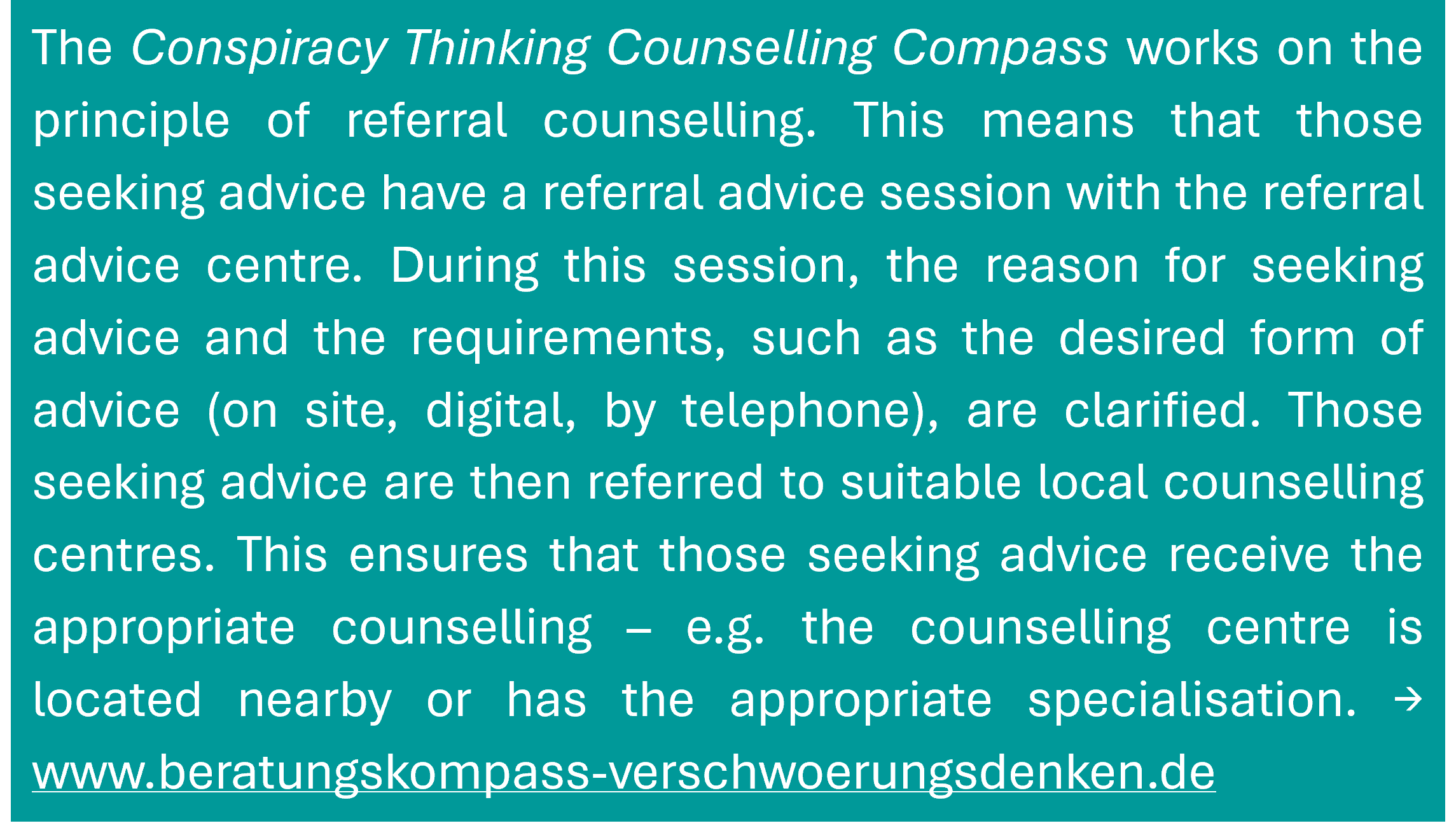
The involvement of the actors in the design of the referral consultation, i. e. the first contact between those seeking advice and the referral advice centre, which then refers them to a suitable (local) advice centre depending on their concerns, location and other requirements, is clear. While it was still unclear in the concept of the association of organisations whether the initial contact between those seeking advice and the referral counselling centre would be a single or multiple consultations, or a short or detailed consultation, the exchange formats clearly revealed the needs of the counselling landscape: The referral consultation should be as brief as possible and aim only to clarify the facts and make the referral, so as not to create an actual counselling situation that may be difficult for the counselling centre receiving the referral to follow up on.
Through the implementation of feedback, ongoing involvement in the development of guidelines, documents and processes, and numerous multilateral and bilateral consultation, discussion and information formats, it was ultimately possible to win over many actors for collective action, despite initial systemic obstacles. The result is a functional referral counselling structure and an expanded network of educational and informational services.
4. Cross-network needs
Against the backdrop of the general obstacles outlined above for networking projects in the field of extremism prevention and the concrete experiences gained in connecting existing information, education and counselling services on the topic of conspiracy ideologies and conspiracy thinking, various general and specific needs become apparent that must be taken into account when transferring the approach.
1.) In order to effectively establish, maintain and revitalise networks in the field of P/CVE and related social areas, the systemic obstacles must first be addressed. Adequate (human) resources through long-term and appropriate funding, the continuation of projects and services, and better planning are the basis for networking that is not perceived as an additional and almost unbearable burden.
2.) Within the counselling landscape on conspiracy ideologies and conspiracy thinking, it has become apparent that in this still relatively young field of counselling, there is a need for, among other things, greater (specialist) public visibility of the counselling field with its similarities and differences to other areas of extremism prevention, as well as networking with the “Landesdemokratiezentren (federal democracy centres)” and relevant state and municipal actors, such as the state youth welfare offices.
3.) Other needs within the network are also related to this still young field of counselling. For example, many actors find it important to see
- further clarification of roles in the field,
- greater consolidation of the counselling and professional field, and
- further professionalisation while maintaining their own professional independence.
5. Outlook: Networking potential with information projects and research
One aspect that is particularly important for the structuring function of networking projects is in-depth networking with information projects and research. The focus of networking in the counselling and prevention landscape was the specific project of establishing a functional referral service. This included the development of common standards and processes. Networking with relevant information projects and research, on the other hand, involved recording data as part of the inventory survey and exchanging information at face-to-face networking meetings. Networking in and between these sub-areas of the prevention landscape is particularly rewarding, and it is recommended that funding bodies, practitioners and academics continue to intensify these efforts in the future. The need and potential for even more intensive networking in the information, education and research landscape remains high: counselling and education services can benefit from the latest research findings, while research projects can benefit from empirically relevant insights from counselling and education projects. The project „Further development of prevention and counselling on conspiracy thinking in connection with extremist attitudes“ contributes to this desirable further networking, among other things through a project-specific digital exchange platform and the establishment of relevant exchange formats.
6. Reflection: Conditions for success and best practice
Looking back on the implementation process to date, a number of conditions for success and best practice recommendations can be identified from the „Verweisberatung Verschwörungsdenken (referral counselling network for the prevention of conspiracy thinking)“ project. Fundamental to the success of networking and the establishment of a functional referral structure is 1) the scientific recording of the prevention landscape and all its actors, without which effective engagement is impossible. This is followed by 2) transparent communication with all actors, 3) participatory and needs-oriented development of joint processes, and 4) the offering of various participation formats, including resource-saving ones (digital workshops, feedback on documents via email, bilateral meetings and discussions, in-person networking meetings) are crucial for building the necessary trust. Finally, it seems that – and this is not surprising given the nature of a field of work characterised by high intrinsic motivation and conviction among the actors involved – 5) a genuine interest in improving the respective field of counselling and prevention is of great importance for the success of a comparable networking project.
Author:
Till Wagner studied history, political science and interdisciplinary anti-Semitism research. He has worked in exhibition design and political education and has been coordinating and designing education and prevention projects in the field of P/CVE at Violence Prevention Network since 2023. He also works as a freelance author, e. g. for the specialist portals Soziopolis and the blog of the Journal of the History of Ideas.
 INTERVENTIONEN