This article was originally published in German (dist[ex] monitor 2. Quartal 2026) and was automatically translated for international dissemination.
By monitoring team (Violence Prevention Network)
In the context of Adolf Hitler’s so-called Führer’s Birthday on 20 April, we have taken a closer look at the annual activities associated with right-wing extremism. We analysed the enduring symbolic power and significance of figures and events from the Nazi era. We also examined why and how these continue to be ideologically appropriated and exploited to this day.
20 April, which was celebrated under National Socialism as a propagandistically staged public holiday featuring mass marches, tributes and declarations of loyalty to Adolf Hitler, continues to hold symbolic significance in the far-right scene as the Führer’s birthday. Open celebrations are rare, as they may constitute a criminal offence. Instead, activities are increasingly shifting towards covert or coded forms. Far-right activities around 20 April may take the form of events deliberately scheduled for this date, such as concerts or social evenings, so that the connection with Hitler’s birthday is not immediately apparent to outsiders. Within the scene, however, the background to events on this date is clearly recognised. Once again, far-right extremists are using codes and symbolism that serve as identifying markers internally, whilst serving to disguise and obscure their true nature to the outside world. This approach is well known, for example, through numerical codes such as 88 on certain clothing brands.
On social media, the significance of 20 April is evident in content such as memes, propaganda or so-called celebratory posts. Messages frequently appear in which the content is obscured by means of (numerical) codes, e. g.:
– Happy 20 April
– Numeric codes such as 1889 (Hitler’s year of birth)
– Hidden date codes such as 204
– Emojis such as ⚡⚡, representing the SS’s double victory rune, or 🙋♂️, representing the Hitler salute
Another recent example is a Schnitzel Buffet on 20 April at the scene-trendy pub Eiserner Löwe (Iron Lion), organised by neo-Nazi Tommy Frenck (see Fig. 1). Frenck has been a central figure in the far-right scene for years and is active, amongst other things, as an organiser of right-wing rock events, a far-right entrepreneur and a political actor within the sphere of far-right parties and voter groups. His venue is specifically used as a meeting place and networking hub.
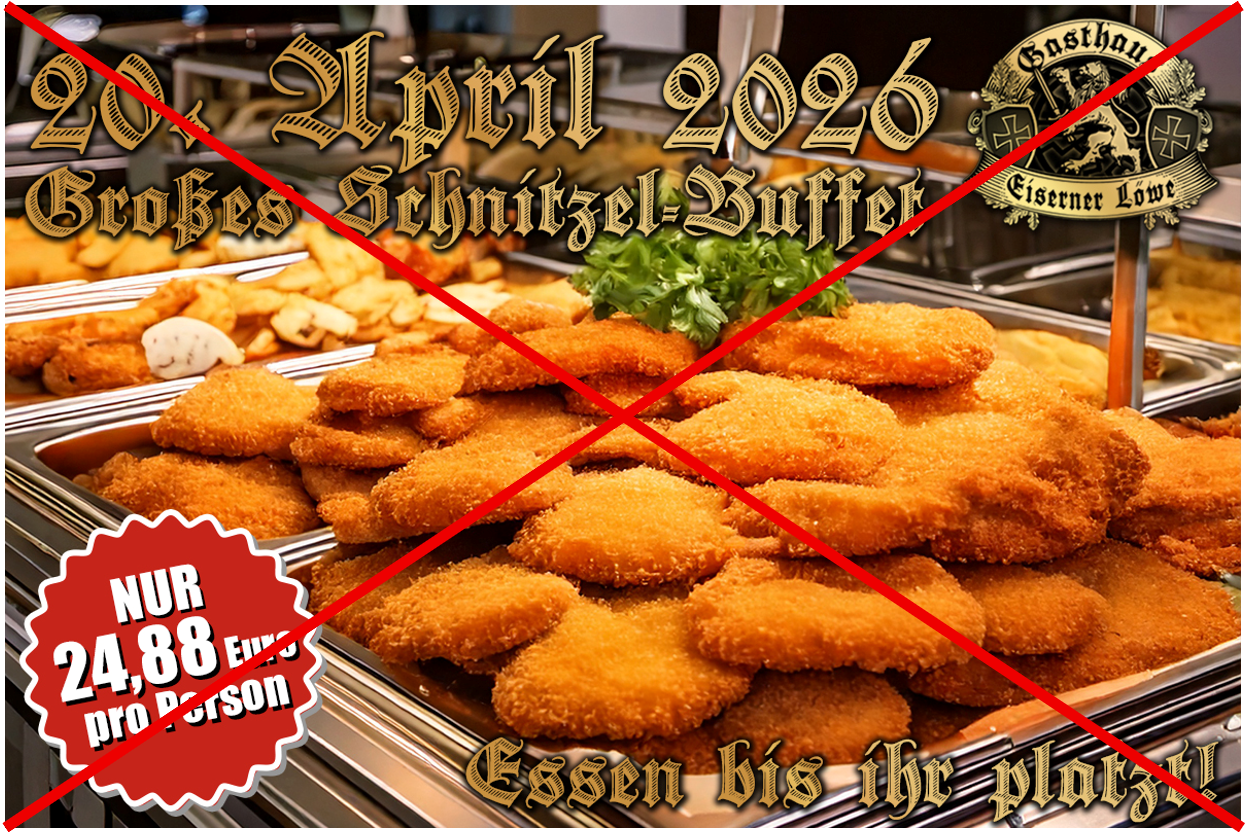
Frenck is known for his use of far-right codes. For instance, on previous occasions[1], offers on 20 April have repeatedly been advertised with prices such as €8.88 or €14.88, or these figures have been used for merchandise in his online shop. These are numbers which are understood within the scene as clear allusions to National Socialist ideology (88 as an abbreviation for HH, 14 referring to the 14 Words of David Lane’s racist creed: “We must secure the existence of our people and a future for white children.”[2]). AfD politician Martin Wieser, who was later convicted in a final judgement for using a banned Nazi slogan on social media[3], also came under criticism in 2024 after he was alleged to have liked a Facebook post reading Happy Birthday!! alongside a picture of Adolf Hitler’s birthplace.
These examples show that far-right figures continue to make direct references to historical National Socialism and Adolf Hitler. In some cases, they attempt to deny their actions; in others, they openly flirt with their crimes. This is also evident in posts that refer to the crimes of the Wehrmacht.
What used to be a marginal phenomenon is now spreading rapidly via social media right into the heart of public discourse and is being taken up, both online and offline, by various figures within the New Right: for example, Wehrmacht nostalgia. Under hashtags such as #SaveEurope, for example, the Nazi regime is increasingly portrayed as a supposed protector of Europe. These narratives tie in with current crises and uncertainties and pit a supposedly true Europe against existing pluralistic societies – in an emotional, simplistic and deliberately mobilising manner.[4] [5]
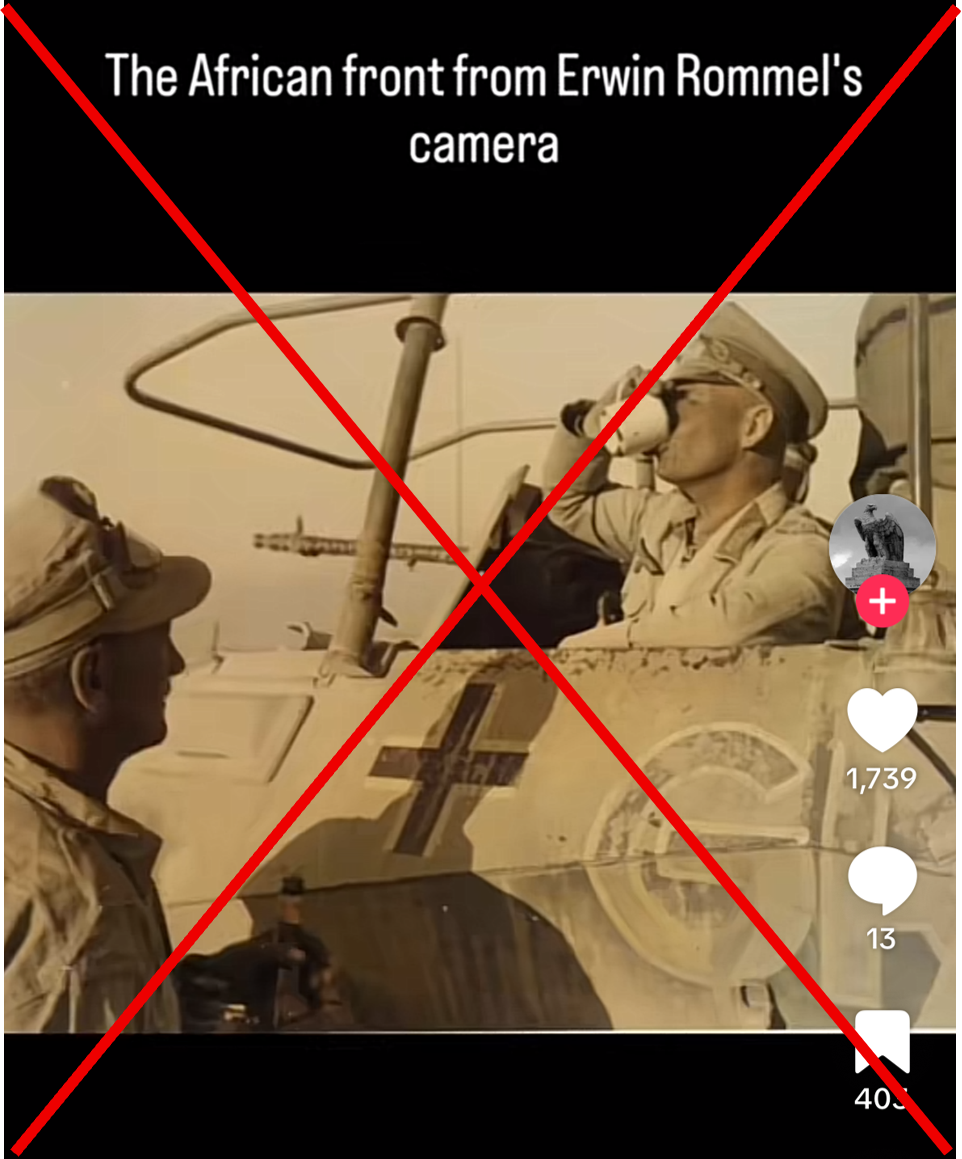
The foundation of these narratives is the factually incorrect claim of the clean Wehrmacht. This narrative emerged shortly after 1945 and portrays the Wehrmacht as an apolitical, honourable army. Today, this narrative is being revived and simplified online: the Second World War is portrayed as an act of defence, violence is relativised and responsibility is glossed over. This is accompanied by images and posts, such as photographs of the 1943 African Campaign in nostalgic sepia tones (see Fig. 2). These are intended to appear harmless, but they convey a heroic view of history and ideals of military masculinity. Such interpretations are exploited for political ends, for example with statements such as: Our ancestors were not criminals, which address potential personal connections – for example, through (former) members of the Wehrmacht or the NSDAP within the family circle – and relativise historical responsibility.[6] Today, this content is primarily disseminated via visually striking, algorithm-friendly formats on platforms such as TikTok and Instagram.
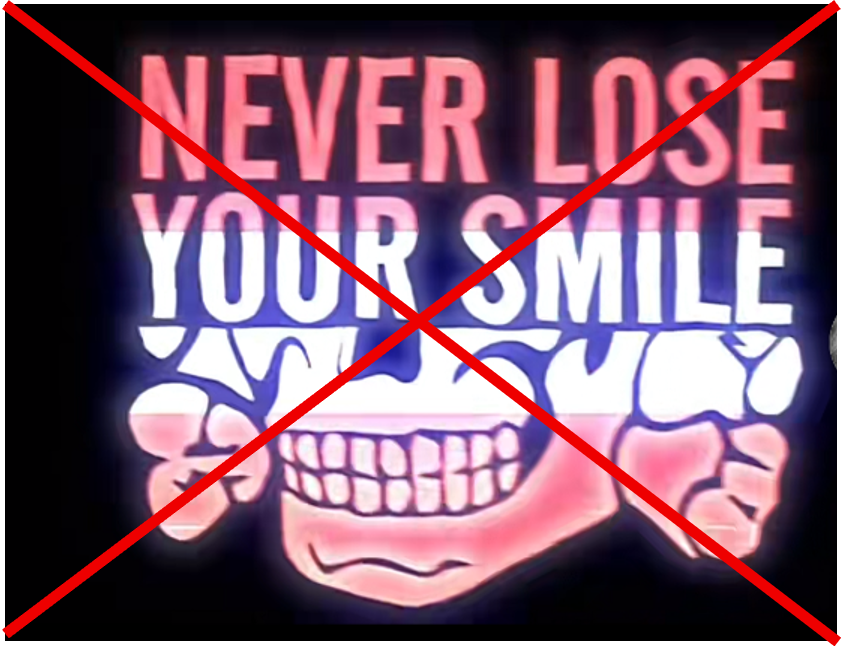
Trends such as Aryan Classic combine Nazi imagery – such as sculptures by Arno Breker – with modern Fashwave aesthetics: neon colours, retro gaming looks, short loops and epic soundtracks. Elements of Christian symbolism, Orthodox imagery or folkloric customs are often mixed in as well to stage a seemingly European identity. This identity has traditionalist, masculine and military connotations and is based on the denigration of (supposedly) other cultural spheres. An unspoken opposition to migrants is constructed, extending to more far-reaching political demands such as a Fortress Europe. In this way, historical contexts are obscured, whilst emotions of nostalgia and perceived loss are amplified. This is precisely what makes them so effective: Nazi references are not explained but felt.[7]
Against the backdrop of the Nazi past, a supposed saviour myth and the notion of a global conspiracy are also propagated. In this context, the year 1945 is interpreted as a European loss of soul. In these narratives, the Nazi regime is glorified as Europe’s supposed protective power. The war is portrayed as a pre-emptive strike or defence against a fabricated enemy such as Jewish Bolshevism.
Today, this narrative is being perpetuated and normalised: terms such as globalist elite or Great Replacement are increasingly appearing in broader online discourse, often without clear contextualisation, but with strong anti-Semitic undertones. The Wehrmacht serves as a historical symbol of resistance in this context. Thus, the war of extermination is gradually being reinterpreted from a crime into a supposed rescue mission for Western culture. In far-right narratives, the German defeat in 1945 is not portrayed as a liberation – but as the loss of Europe. The defeat is presented as the moment when Europe allegedly lost its soul. Europe is portrayed as a collection of ethno-national states. This ties in with narratives of external control: ranging from alleged American dominance to the EU as a project of de-Europisation that destroys identity, family and tradition. At the same time, a notion of European superiority is constructed, one that was supposedly crushed at that time. On social media, this gives rise to a new far-right, collective identity based on a blood and soil ideology. These narratives deliberately foster a sense of loss and rootlessness – and offer, as a solution, a radical rebirth of Europe founded on authoritarian and exclusionary ideals.
The success of these narratives is closely linked to the functioning and communicative developments of online platforms. Situational storytelling now dominates social media: instead of stable, verifiable historical narratives, fragmented content emerges in which facts, half-truths and deliberate reinterpretations are intermingled. Context is lost – what matters is what resonates emotionally.[8]
History thus becomes a flexible tool, not for enlightenment, but for forging identity and distinguishing oneself from a supposed Other.[9] Taken together, the examples shown give rise to a modern, European-infused far-right narrative: emotional, visually appealing and easily relatable. It pushes the boundaries of what is acceptable to say, normalises problematic interpretations and makes the ideology easy to consume.
[1] Baden-Württemberg Office for the Protection of the Constitution: “New study by the LfV: ‘Schnitzel for 14.88 euros. The sources of income for right-wing extremists in Germany’”, verfassungsschutz-bw.de, 2 October 2024: https://www.verfassungsschutz-bw.de/,Lde/Startseite/Meldungen+und+Archiv/Studie_+Schnitzel+fuer+14_88+Euro (last accessed: 5 May 2026).
[2] Federal Office for the Protection of the Constitution: ‘Right-wing extremism: symbols, signs and banned organisations’, Federal Office for the Protection of the Constitution 2022: https://www.verfassungsschutz.de/SharedDocs/publikationen/DE/rechtsextremismus/2022-02-rechtsextremismus-symbole-zeichen-organisationen.pdf?__blob=publicationFile&v=10 (last accessed: 5 May 2026).
[3] Jörg Eschenfelder: “Martin Wieser’s conviction becomes final”, ovb-heimatzeitungen.de, 23 December 2025: https://www.ovb-heimatzeitungen.de/wasserburg/2025/12/22/martin-wieser-rechtskraeftig-verurteilt-2.ovb (last accessed: 7 May 2026).
[4] Daniel Keil: “Europe against the EU: Updates on far-right visions of Europe during the EU crisis”, ZRex – Journal of Research on Right-Wing Extremism, 4(2), pp. 230–248, 2024.
[5] Jonathan Suseno Sarwono: “Yup, Another Far-right Classic: The Propagation of Far-right Content on TikTok in Malaysia, Indonesia, and the Philippines”, GNET, 8 November 2023: https://gnet-research.org/2023/11/08/yup-another-far-right-classic-the-propagation-of-far-right-content-on-tiktok-in-malaysia-indonesia-and-the-philippines/ (last accessed: 4 May 2026).
[6] Susanne Gaschke: “‘Our ancestors were not criminals’: AfD lead candidate Krah wants to ‘destroy’ the Christian Democrats – with the help of voters of Turkish origin’, nzz.ch, 7 September 2023: https://www.nzz.ch/international/afd-spitzenkandidat-krah-deutsche-vorfahren-keine-verbrecher-ld.1755120 (last accessed: 7 May 2026).
[7] Fabian Virchow: “Narratives of the far right: Far-right narratives on social media”, BZKJ aktuell, February 2024: https://www.bzkj.de/resource/blob/240364/b4c3068e23fba890d814b80fa76d3306/20242-narrative-der-extremen-rechten-data.pdf (last accessed: 7 May 2026).
[8] J. Krameritsch: ‘The Five Types of Historical Narrative – in the Age of Digital Media’, Zeithistorische Forschungen/Studies in Contemporary History, 8(3), pp. 413–432, 2024.
[9] Fabian Virchow: “Narratives of the Far Right: Far-Right Narratives on Social Media”, BZKJ aktuell, February 2024: https://www.bzkj.de/resource/blob/240364/b4c3068e23fba890d814b80fa76d3306/20242-narrative-der-extremen-rechten-data.pdf (last accessed: 7 May 2026).

