This article was originally published in German (Interventionen 20/2026) and was automatically translated for international dissemination.
Original article by Maximilian Campos Ruf and Sandra Schwarz
Children and youth have become one of the most debated topics of prevention and countering of violent extremism (P/CVE) and counter-terrorism (CT) efforts internationally. New analyses and studies are published almost daily, each painting an even more dramatic picture of how much the number of children and youth involved in extremist radicalisation and terrorist groups has risen in recent months and years. While such numbers and statistics are important for highlighting the urgency of the issue and generating momentum to develop and implement new, comprehensive measures for P/CVE as well as child and youth protection, they are only one building block on this path. Developing sustainable solutions that respect children’s and youth’s rights, requires a deeper understanding not only of the scale of the problem, but of the underlying pressures and needs. To contribute to this understanding, the following article begins by briefly highlighting the numerical scale of the issue in Germany and internationally. This is followed by an in-depth look at psychological research to identify causal mechanisms contributing to this worrying trend, and to develop further recommendations.
Children, youths, radicalisation, and violence: what do the numbers tell us?
In 2025, 42% of terrorism-related investigations in Europe and North America involved young people and minors, as data from the Global Terrorism Index shows, a threefold increase from 2021 (Institute for Economics & Peace 2026). And even though out of 31 planned attacks involving minors, 97% were prevented by security authorities (n=30), these numbers are nonetheless cause for concern. Statistics on politically motivated crime in Germany confirm this. The Federal Criminal Police Office’s data on politically motivated violence reveals a significant rise in the number of male juvenile suspects aged 14–17, from 190 in 2018 to 312 in 2024. A significant rise is also evident among female juvenile suspects, from 29 in 2018 to 130 in 2023, before dropping to 59 cases in 2024 (see Figure 1).

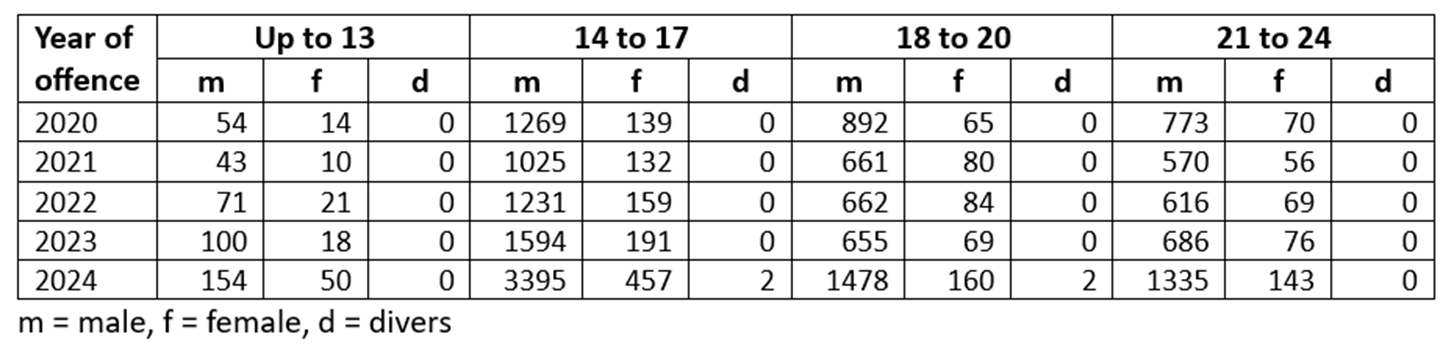
Such clear increases, particularly in relation to terrorist activities and politically motivated violent crime, suggest that the figures regarding other types and trajectories of extremist radicalisation and associated crime could be significantly higher still. And indeed, the data on the area of politically right-wing motivated crime also shows a particularly striking increase in the 14- to 17-year-old age group (see Figure 2, Federal Government 2025). However, numbers are on the rise in all age groups, from children under 13 to young adults aged 21-24:
A look at P/CVE practice also clearly shows that, in the two largest topical areas in Germany – Islamist extremism and right-wing extremism – the organisations working in these fields consistently report an increase in cases involving minors. Although young people, particularly those aged 14 and over, have long been a significant target group of P/CVE, the challenge has shifted once again. Increasingly, even children, some as young as ten, are being referred to counselling centres in connection with extremist activities and/or groups, and increasingly so in the context of security concerns, a propensity for violence, or even violent behaviour (Becker & Götz 2025; Bundesverband Mobile Beratung 2025, Dantschke 2025, Hell 2025; Komarek 2025; Violence Prevention Network 2026).
Added to this are increasingly hybrid extremist phenomena that have so far eluded the existing official categorisation and funding practices, leaving broad gaps in detection and prevention systems. This also includes phenomena such as nihilistic violence or so-called “nihilistic violent extremism”, whose best-known networks – “764”, “The Com” and structures surrounding “Maniac Murder Cult” and the “True Crime Community” – have gained particular traction. There, a digital ecosystem is unfolding that combines elements of gore[1], self-harm, incitement to suicide, sexual exploitation, paedophile crime and the glorification of mass murderers, amongst other things, with ideological motifs from accelerationism[2] and aesthetics drawn from occult neo-Nazism. These networks specifically target vulnerable children and young people with pre-existing mental health issues, with the aim of inciting them to self-harm, suicide or other forms of violence, incl. mass violence. Other children are also recruited there and encouraged, pressured or blackmailed into becoming perpetrators themselves. These complex ‘perpetrator-victim dynamics’, which frequently affect very young people, pose a major challenge for practitioners and authorities. The most prominent case in Germany to date is that of alleged perpetrator ‘White Tiger’, Shahriar J., who is currently on trial in Hamburg. Internationally, ‘764’ and ‘Maniac Murder Cult’ have already been designated as terrorist organisations by Canada (Public Safety Canada 2025). Due to the fact that ideological references and links are not always obvious and explicit, as well as the sheer breadth of converging problem areas, spanning paedocriminality, sextortion, vandalism, self-harm, child and youth protection issues, among others, existing prevention and detection frameworks often fail to properly act in relation to this phenomenon. This creates a significant barrier to developing coherent responses in terms of victim protection, prevention, and prosecution.
Psychosocial stressors and their consequences for children and adolescents
Children and adolescents around the world are currently growing up in multi-crises environments. Climate change, wars, economic uncertainties, social polarisation, poorly regulated social media channels, and the aftermath of the COVID-19 pandemic shape their lives and influence their socio-emotional development as well as their mental health. International data shows a significant rise in mental health issues: globally, approximately one in seven young people aged 10–19 suffers from a mental health condition, and most disorders develop before the age of 24 (United Nations Youth Office 2025). Suicide is one of the leading causes of death among adolescents worldwide (WHO 2025).
When looking only at the German context, similar trends can be observed. For instance, according to the representative longitudinal COPSY study (2020-2025), over 20% of children and adolescents in Germany continued to report mental health issues or a reduced quality of life in autumn 2025 – a similar proportion to 2024 and approximately 7% more than in the pre-pandemic BELLA study (cf. Kaman et al. 2025). Girls and young women tend to be particularly affected, as do children and adolescents growing up in socio-economically disadvantaged households or whose parents suffer from a mental health condition.
The COVID-19 pandemic is regarded to be a key driver of these developments. Internationally, school closures and lockdowns disrupted young people’s daily routines and social environments – particularly school, leisure activities, and peer interactions – thereby undermining key protective factors for the development and well-being of children and adolescents (UNICEF 2021).
The consequences include an increase in internalising and externalising behaviours (see also Martinsone et al. 2022). According to international studies, symptoms of anxiety and depression among children and adolescents rose dramatically during the pandemic (in some cases by 30-50%), particularly among older adolescents and girls (Panchal et al. 2023; Racine et al. 2021; UN Youth Office 2025). An increase in irritability, withdrawal, and concentration difficulties was also observed, as well as risky behaviour such as increased substance use among older youths (UNICEF 2021; Panchal et al. 2023). According to the longitudinal study by Martinsone et al. (2022), adolescents often showed no improvement or even a decline in social-emotional skills and resilience over a seven-month period during the pandemic. Screen time and sleep problems increased, while physical activity decreased (UNICEF 2021). Although several years have passed since the pandemic, the findings suggest that many children and adolescents continue to struggle with its consequences.
Other current global crises, such as climate change, wars or economic uncertainties, also impact young people’s mental health negatively. Thus, children and adolescents increasingly report crisis-related fears about the future and feelings such as despondency, insecurity or hopelessness associated with these fears (Kaman et al. 2025; Lawrance et al. 2022; United Nations 2025). Social factors such as loneliness, discrimination and a lack of support constitute an additional burden. The digital environment is ambivalent in this context: it offers spaces for communication, yet at the same time it may constitute an independent stressor and amplifier of emotional strain (Kaman et al. 2025).
The afore-mentioned crises and stressors have a particularly negative impact during adolescence. In this phase, identity formation, the search for meaning and the desire for social belonging are central to development. If mastering these developmental tasks becomes more challenging due to persistent insecurity, social isolation or a lack of support, emotional vulnerability may increase, and a reduced development of effective coping mechanisms as well as risky or aggressive behaviour may be the result (Martinsone et al. 2022; Aral & Kadan 2023). In combination with psychosocial stressors and an intensive use of digital media, susceptibility to simplistic worldviews, polarising narratives, and group-related prejudices heightens.
Possible links to the extremist radicalisation of children and youth
To date, there has been a lack of specific research into when children begin to develop political ‘worldviews’ or from what age onwards, one can even speak of radicalisation among children and youth (Reifen-Tagar & Cimpian 2022). However, Reifen-Tagar and Cimpian (2022) point out that children already learn to distinguish between their own in-group and out-groups, and to develop social norms, and an understanding of social hierarchies from early childhood on, according to which they act or classify the behaviour of others. These ‘protopolitical’ attitudes in children vary individually and appear to be linked, among other things, to the political ideologies held by their parents and whether they are growing up in a highly conflict-affected context (e.g., Israel-Palestine) (Reifen-Tagar & Cimpian 2022). The authors therefore strongly advocate for more studies to be conducted at the intersection of developmental psychology and political psychology, particularly concerning children under the age of 13. The following section highlights possible links between the current psychosocial stresses faced by children and adolescents and the rise in extremist radicalisation among minors.
Several studies suggest that psychosocial stress, emotional vulnerability, and a lack of social connection can increase susceptibility to extremist ideologies. Campelo et al. (2018) describe the risk factors for radicalisation at three levels:(1) Individual: emotional vulnerability, personal insecurity, perceived injustice, traumatic experiences, and adolescence. (2) Microsocial: family conflicts, friendships with radicalised individuals. (3) Macrosocial: societal tensions, social radicalisation, political conflicts.
Oppetit et al. (2019) point out that, when compared to radicalised adults, radicalised minors are more likely to exhibit psychological distress, including self-harming behaviour, and are more likely to first come into contact with extremist ideologies via social media and digital platforms.
Concerning the use of violence, Jahnke et al. (2023) also identify specific social risk factors for politically motivated violence among young people, including friends with racist or violence-supporting attitudes, membership of groups that explicitly distance themselves from the supposed ‘mainstream’, and parental violence. This is consistent with practical experiences in P/CVE counselling work. For instance, practitioners report that in cases of youth violence, domestic violence often plays a significant role (Aktaş & Mücke 2025).
These findings illustrate that young people who are burdened by multiple crises, are emotionally unstable, or receive little social and family support may be particularly vulnerable to radicalising influences. If they encounter extremist ideologies during such phases, for example via social media, these may be perceived as offering way out: they provide simple explanations, clear enemy stereotypes, meaning and direction, as well as a sense of belonging and recognition, thus addressing key adolescent needs. For young people experiencing loneliness, exclusion or discrimination, such groups and ideologies can therefore exert a particularly strong pull.
Practical P/CVE experience confirms this link in the context of current developments. Young clients with right-wing extremist backgrounds who turn to Violence Prevention Network for counselling often grow up in socio-economically precarious circumstances, are alienated from their parents, and are accustomed to rapidly escalating cycles of conflict with their parental environment and child and youth welfare professionals (Hell 2025). By comparison, the extremist groups they join offer activities that appear exciting and welcoming: trips to other major cities, often to take part in demonstrations, or joint martial arts trainings to demonstrate and experience strength, the intimidation of supposed opponents and engaging in provocations all serve the search for belonging, occupation, orientation and meaning, whilst simultaneously feeding feelings of frustration and hatred (ibid.). This creates a world of activity and experience that appeals to young people in similar situations and is promoted and disseminated via social media and messaging services. A clear ideological understanding is rarely present here (ibid.).
Conclusion
Research and practice clearly show that children and young people are under considerable psychological, social, and emotional pressure. In addition, there are a number of well-documented risk factors that can facilitate radicalisation processes. Worryingly, these risk factors currently apply to the lived reality of a particularly large number of children and young people in Germany and internationally. But the challenge does not stop there: the increase in very young clients in counselling practice, as well as the rise in cases of politically motivated (violent) crimes committed by children and youth in recent years, shows that this is not merely a matter of theoretical risk. These factors have already translated into actual radicalisation processes and, in some instances, violence.
These developments serve as a clear warning signal that must be taken seriously. They require a number of very concrete measures to effectively counter the rise in extremist radicalisation and politically motivated violence among children and adolescents.
These concrete measures should be accompanied by a fundamental improvement regarding the culture of debate and long-term measures to empower and safeguard children and young people. The aim should be to protect and empower children and young people in the long term and to involve them as able and active participants with independent agency, rather than simply viewing them as deficient objects of discussion.
Fostering practical P/CVE:
- Ideology-agnostic P/CVE approaches should be fostered. Funding structures must be adapted accordingly to allow for flexibility commensurate with the complexity of the issue and to close existing identification and prevention gaps.
- Gender-sensitive and gender-responsive approaches, including violence-prevention work with girls and boys, should be expanded.
- Practitioners’ increasing focus on younger client groups should be supported.
Protecting children and young people:
- Programmes that address the interplay between psychological stress and radicalisation processes must be strengthened and expanded.
- Disadvantaged children and young people must receive specific support, especially in neighbourhoods or regions where extremist groups are particularly active.
- Social media platforms must be held accountable to consistently apply existing legal regulations and to implement protection and prevention measures. Any violations must be sanctioned.
Strengthening families and youth work professionals:
- Specialised awareness-raising and training measures are needed for family members, teachers, and other professionals in child and youth welfare services, providing knowledge on the use of the internet and social media by children and adolescents. Professionals’ confidence in their own ability to deal with extremist narratives and hate speech in daily practice must be enhanced.
- Classic work fields of and child and adolescent psychiatry require awareness-raising and training programmes, as well as systematic connection to P/CVE and violence prevention practice. In doing so, their confidence in dealing with clients’ extremist radicalisation and possible violent ideation can be strengthened.
- Networks between classic work fields in child and youth welfare, psychiatry, child and youth protection, as well as P/CVE and law enforcement must be strategically established and strengthened. This is a necessary step towards responding coherently and effectively to the challenges posed by contemporary forms of hybrid extremism and violence.
- Educators must be (re-)empowered to engage constructively with children and adolescents, even on complex political and social issues.
Only very few radicalisation processes lead to politically motivated crime, violence or even terrorism. Conversely, however, this also means that the well-documented increase in cases of violent radicalisation represents merely the tip of an ever-growing iceberg, beneath which lies an equally growing hidden realm of social alienation and autocratisation. Only by reducing psychosocial stress and strengthening protective factors at all levels of society can children and young people be empowered to develop the skills to cope with crises, live by democratic values, and resist extremist narratives.
Authors:
Maximilian Campos Ruf is a scholar of Islamic and social sciences specialising in terrorism and security studies. He has been working at Violence Prevention Network gGmbH since 2017, currently serving as Director of the Research Department and as Senior International Adviser.
Sandra Schwarz holds a Master’s degree in Clinical Psychology and Psychotherapy as well as a Master’s degree in Human Rights and Intercultural Development. She has been working in the Psychotherapy Department of Violence Prevention Network gGmbH since 2025 and is responsible for the focus area ‘Radicalisation of Children and Young People’.“
[1] Digital subcultures focused on the discussion and dissemination of real depictions of extreme violence and bodily harm.
[2] Accelerationism refers to the ideology of deliberately accelerating the perceivably inevitable collapse of the existing political and social systems through targeted attacks and violence and is particularly prevalent in right-wing extremist scenes. Subsequent to this collapse, accelerationist groups usually envision the establishment of a new, utopian order; in the case of nihilistic violence, however, this element is absent, with destruction and chaos taking centre stage instead.
Primary sources
Background interview with Feride Aktaş and Thomas Mücke – Department of Islamism, 27 November 2025.
Background discussion with Peter Anhalt – Department of Right-wing Extremism, 20 November 2025.
Focus group discussion with several counsellors from Violence Prevention Network, 9 February 2026.
Bibliography
Aral, N., & Kadan, G. (2023). Child development in a crisis: A pandemic. In Integrated Science of Global Epidemics (pp. 529-544). Cham: Springer International Publishing.
Becker, L. et al. (2025). Ever younger, ever earlier? Social media, early ideologisation and new demands on civil society’s work on distancing and disengagement. dist[ex] – Development of a centralised national infrastructure for distancing and disengagement work. Available at: https://www.dist-ex.de/publikationen/detail/immer-juenger-immer-frueher-soziale-medien-fruehe-ideologisierung-und-neue-anforderungen-an-die-zivilgesellschaftliche-distanzierungs-und-ausstiegsarbeit (Accessed: 27 February 2026).
Federal Office for the Protection of the Constitution (2025). Response to a written enquiry from Violence Prevention Network gGmbH.
Federal Criminal Police Office (2025). Response to a written enquiry from Violence Prevention Network gGmbH.
Federal Government. (2025, 6 October). Response from the Federal Government to the minor parliamentary question from MPs Marlene Schönberger, Schahina Gambir, Marcel Emmerich et al. and the BÜNDNIS 90/DIE GRÜNEN parliamentary group: Young and far-right – On the rise in far-right attitudes and propensity for violence among adolescents and young adults (German Bundestag, Printed Paper 21/1990). https://dserver.bundestag.de/btd/21/019/2101990.pdf
Federal Association for Mobile Counselling (2025). How right-wing extremism takes root in everyday life – and how activists are fighting back. Available at: https://bundesverband-mobile-beratung.de/publikationen/wie-sich-rechtsextremismus-im-alltag-festsetzt-und-engagierte-dagegenhalten/ (Accessed: 27 February 2026).
Dantschke, C. (2025). Counselling cases with security implications – Insights into the changes and challenges faced by the ‘Hayat’ counselling centre of the Grüner Vogel e. V. association, in Grüner Vogel e. V. (ed.) Symposium – ‘The attackers are getting younger and younger’. Challenges for prevention work in the tension between youth protection and public safety. Grüner Vogel e. V., pp. 11-15. Available at: https://gruenervogel.de/wp-content/uploads/2025/07/GruenerVogel_Fachtag_2025_Jugendradikalisierung.pdf (accessed 10 March 2026).
Hell, E. (2025). Young & Precarious – The New Right-Wing Youth, in Violence Prevention Network (ed.) Interventions. Available at: https://interventionen.blog/2025/06/24/jung-prekar-die-neue-rechte-jugend/ (accessed 10 March 3036).
Institute for Economics & Peace (2026). Global Terrorism Index 2026. Available at: https://www.visionofhumanity.org/wp-content/uploads/2026/03/Global-Terrorism-Index-2026-Report.pdf (Accessed: 26 March 2026).
Jahnke, S., Abad Borger, K., Burgsmüller, L., Hoppe, C., & Beelmann, A. (2023). A meta-analysis on the link between young people’s social environment, socioeconomic status, and political violence outcomes. International Journal of Developmental Science, 17(1-3), 19-29.
Kaman, A., Devine, J., Erhart, M., Napp, A. K., Reiss, F., Freitag, C. M., & Ravens-Sieberer, U. (2025). Current Global Crises and Youth Mental Health in Germany: The Role of Media Use, Coping and Resources. Research Square. https://doi.org/10.21203/rs.3.rs-8260872/v1.
Komarek, M. (2025). Foreword, in Grüner Vogel e. V. (ed.) Symposium – ‘The perpetrators are getting younger and younger’. Challenges for prevention work in the tension between youth protection and public safety. Grüner Vogel e. V., pp. 9-10. Available at: https://gruenervogel.de/wp-content/uploads/2025/07/GruenerVogel_Fachtag_2025_Jugendradikalisierung.pdf (Accessed: 10 March 2026).
Martinsone, B., Stokenberga, I., Damberga, I., Supe, I., Simões, C., Lebre, P., Canha, L., Santos, M., Santos, A. C., Fonseca, A. M., Santos, D., De Matos, M. G., Conte, E., Agliati, A., Cavioni, V., Gandellini, S., Grazzani, I., Ornaghi, V. & Camilleri, L. (2022). Adolescent social-emotional skills, resilience and behavioural problems during the COVID-19 pandemic: A longitudinal study in three European countries. Frontiers in Psychiatry, 13, 942692. https://doi.org/10.3389/fpsyt.2022.942692.
Oppetit, A., Campelo, N., Bouzar, L., Pellerin, H., Hefez, S., Bronsard, G., Bouzar, D. & Cohen, D. (2019). Do radicalised minors have different social and psychological profiles from radicalised adults? Frontiers in Psychiatry, 10, 644. https://doi.org/10.3389/fpsyt.2019.00644.
Panchal, U., Salazar de Pablo, G., Franco, M., Moreno, C., Parellada, M., Arango, C., & Fusar-Poli, P. (2023). The impact of COVID-19 lockdown on child and adolescent mental health: systematic review. European child & adolescent psychiatry, 32(7), 1151-1177.
Berlin Police (2025) Arrest warrants and search warrants executed against suspected members of ‘Deutsche Jugend Voran’, Berlin.de Police reports. Available at: https://www.berlin.de/polizei/polizeimeldungen/2025/pressemitteilung.1602423.php (Accessed: 27 February 2026).
Public Safety Canada (2025) Government of Canada lists for new terrorist entities, Canada.ca. Available at: https://www.canada.ca/en/public-safety-canada/news/2025/12/government-of-canada-lists-four-new-terrorist-entities0.html (Accessed: 10 March 2026).
Racine, N., McArthur, B. A., Cooke, J. E., Eirich, R., Zhu, J., & Madigan, S. (2021). Global prevalence of depressive and anxiety symptoms in children and adolescents during COVID-19: a meta-analysis. JAMA Pediatrics, 175(11), 1142-1150.
Reifen‐Tagar, M., & Cimpian, A. (2022). Political ideology in early childhood: Making the case for studying young children in political psychology. Political Psychology, 43, 77-105.
Robert Bosch Stiftung (2024). German School Barometer: Survey of pupils. Findings from 8- to 17-year-olds and their parents or guardians on well-being, quality of teaching and help-seeking behaviour. Robert Bosch Stiftung.
tagesschau.de (2025) Pre-trial detention for five suspected right-wing terrorists. Available at: https://www.tagesschau.de/inland/rechte-terrorzelle-u-haft-100.html (Accessed: 27 February 2026).
UNICEF (2021). The State of the World’s Children 2021: On My Mind—Promoting, Protecting and Caring for Children’s Mental Health. https://eric.ed.gov/?id=ED615261. (Accessed: 8 April 2026).
United Nations Youth Office (2025). Youth Mental Health and Well-being Flagship Initiative. https://www.un.org/youthaffairs/sites/default/files/2025-10/Youth%20Mental%20Health%20Flagship%20Initiative_UN%20Youth%20Office_Nov%202025.pdf (Accessed: 8 April 2026).
World Health Organization: WHO. (25 March 2025). Suicide. https://www.who.int/news-room/fact-sheets/detail/suicide/ (Accessed: 8 April 2026).

