This article was originally published in German (dist[ex] monitor 1. Quartal 2026) and was automatically translated for international dissemination.
By Monitoring team (Violence Prevention Network)
Our monitoring revealed that extremist actors are increasingly turning to podcast formats.[1] But why, in an age of short videos, do extremist actors opt for long-form conversational formats without constant visual changes and stimuli? We will explore this question, using the podcasts of three actors as examples.
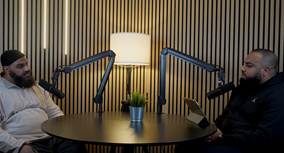
The Salafist preacher Abul Baraa[2] is new to the podcast scene. He posted his first episode, entitled “The Truth About Abul Baraa”, on 3 December 2025. Baraa’s content is published monthly on his regular YouTube channel Abul Baraa Tube, which has over 100,000 subscribers.
In the first two episodes, the preacher is interviewed by Abu Malik. In the first show, Abul Baraa offers personal insights into his life story and talks about the support he experienced from the people when he arrived in Germany.[3] He also discusses the psychological distress caused by his wartime experiences[4], initial difficulties at school[5] and his journey to faith within a family that was not particularly religious.[6] This offers viewers a personal insight that has so far been available only to a limited extent in other formats. Furthermore, the two podcast participants discuss, for example, the supposedly correct way of acquiring knowledge about Islam and paraphrase passages from the Qur’an.[7] Baraa also repeatedly displays advertisements for a website and a book of his available there.
The far-right influencer eingollan[8] has been running the video podcast eingast since early 2025. On her regular YouTube account (around 300,000 subscribers), she mainly posts street interviews; under the eingast account, she has now uploaded around 40 video podcasts and other similar dialogue formats. These episodes are usually around one to two hours long. eingast features numerous well-known figures from the German far right or conspiracist scene, such as Feroz Khan, Ken Jebsen, Coach Aaron (Rohgang), the influencer Clownswelt, and editors from the newspaper Junge Freiheit. The eingast YouTube channel has around 90,000 subscribers. It is possible to become a channel member for 2.99 euros or 9.99 euros a month. The more expensive subscription offers early access to new content as well as access to exclusive videos. The number of views for the videos varies greatly, with individual episodes being viewed between approximately 10,000 and 450,000 times. In the discussions, eingollan not only provides a platform for her guests to express their views, but also disseminates what is at times anti-democratic content herself.
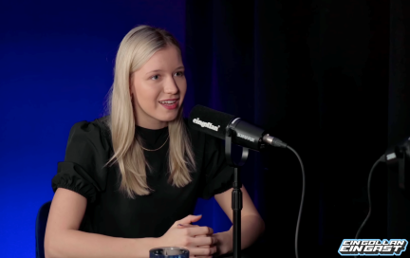
In the episode featuring the German member of parliament Sabine Reinknecht (Alternative für Deutschland), for example, eingollan claims that the treatment of Reinknecht is the best example of how Germany is a sham democracy and gives her guest the opportunity to recount her personal experiences of stigmatisation.[9] The far-right influencer Clownswelt is able to present his perspective on political developments in Germany unchallenged on her podcast.[10]
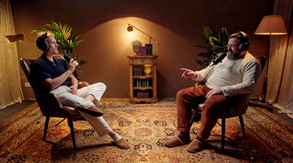
The far-right Christfluencer[11] Ketzer der Neuzeit (Heretic of the Modern Age) (with around 580,000 subscribers on YouTube) has also been regularly publishing video podcast formats since mid-2025.[12] The self-professed Christian has built up his reach in recent years through street interviews in which, for example, he deliberately asked leading questions to those with differing political views, thereby attempting to delegitimise their positions. As with Baraa, his podcasts are hosted via his regular account. They usually last between two and four hours. Three levels of channel membership are available; for 99.99 euros a month, “sponsors” can contact him directly. In his videos, for example, he uncritically provides a platform for the conspiracist Fabian Kowallik of “Rohgang” and also mocks critical reporting on Kowallik’s statements.[13] In another post, he speaks with Tobias Riemenschneider, the leader of a Christian fundamentalist congregation.[14] During the conversation, both link abortions to an alleged genocide of Germans.[15] The core idea of the far-right conspiracy ideology of the ‘Great Replacement’ is thus linked to the Christian debate on a ban on abortion.
Video podcasts are often lengthy, which sets them apart from many short social media posts. At first glance, it may seem surprising why – in an era where reach is maximised through viral short videos – there is a deliberate focus on long-form content. This can be interpreted as a deliberate strategy: through long formats, influencers are able to present a more detailed interpretation of social and political issues than they can with short video messages. The podcasters sometimes employ a suggestive style of conversation and, together with their guests, present a selective or perceived evidence of social issues. The way these ‘discussions’ are conducted is usually asymmetrical and affirming, meaning that controversial positions are rarely challenged.
Furthermore, these long-form content formats serve entertainment purposes; they enable viewers to engage with extremist narratives for longer periods and in a subliminal manner. Some of the episodes are also available on Spotify, making them accessible as audio files on mobile devices. In some cases, they take the form of live streams, which serve as events for the scene or those with an interest. Short clips from the longer formats are also regularly uploaded to social media as teasers to generate attention.
Additionally, podcasts enable these actors to present themselves as an alternative public sphere within pop-cultural and media formats. Extremist figures thus create star-like personas within their scenes, combining an interest in political content with stories from their private lives. Extensive formats and personal insights also make it easier for extremists to establish parasocial relationships[16].
Finally, it should be emphasised that the subscription models mentioned above represent a further monetisation opportunity, operating alongside YouTube advertising or merchandise sales. The payment models discussed point to a target audience that is willing to provide financial support.
dist[ex] – Development of a Network for Disengagement and Exit Work is a collaborative project by BAG Ausstieg zum Einstieg e. V., Grüner Vogel e. V., IZRD e. V., Legato Projektverbund and Violence Prevention Network gGmbH.
[1] Podcasts generally refer to interviews, reports or expert discussions that are regularly published online as individual episodes and made available as video or audio content. They are a widely used format and are utilised by influencers, amongst others. (cf. Sebastian Follmer and Johannes Wiegand: “What is a podcast? Explained simply and clearly”, chip.de, 16 April 2025: https://www.chip.de/ratgeber/hobby-freizeit/was-ist-ein-podcast-einfach-und-verstaendlich-erklaert_42b6246c-f4dd-4853-bf5c-e31db61d3539.html (last accessed: 17 February 2026).
[2] Baden-Württemberg Office for the Protection of the Constitution: “Series ‘Salafist Networks in Transition’ Part 10: Ahmad ABUL BARAA”, verfassungsschutz-bw, 13 December 2022: https://www.verfassungsschutz-bw.de/,Lde/Serie+_Salafist+networks+in+transition_+_+Part+10_+Ahmad+ABUL+BARAA (last accessed: 12 February 2026).
[3] Abul Baraa: ‘Abul Baraa Podcast – The Truth About Abul Baraa’, YouTube, 3 December 2025 (from 10:10): https://www.youtube.com/watch?v=YBYNB5TIASY (last accessed: 12 February 2026).
[4] Ibid., from 12:05.
[5] Ibid., including from 13:25.
[6] Ibid., including from 17:30.
[7] Ibid., including from 31:00.
[8] Gideon Wetzel: “Right-wing women’s network on Instagram – an analysis of new-right influencers and their influence via a right-wing women’s network on Instagram and new-right influencers”, amadeu-antonio-stiftung.de, 2024: https://www.amadeu-antonio-stiftung.de/rechtes-frauennetzwerk-instagram/ (last accessed: 12 February 2026).
[9] eingast: “This is why this AfD MP was ousted from office…”, YouTube, 23 December 2025 (from 0:33/25:28/1:58/6:58): https://www.youtube.com/watch?v=haGzypAs8Kg (last accessed: 12 February 2026).
[10] eingast: “I’m doxxing Clownswelt – big time!🤡 | #11”, YouTube, 12 June 2025: https://www.youtube.com/watch?v=wmbQSb2-MDA (last accessed: 12 February 2026); see also: Jost Maurin: “Right-wing clown drops the mask”, taz.de, 16 May 2025: https://taz.de/Rechter-YouTuber-Clownswelt-legt-Klarnamen-offen/!6088012/ (last accessed: 12 February 2026).
[11] See also: Sarah Pohl: “Holy pretence? Challenges and controversies surrounding Christian influencers”, KN:IX Impuls on bag-relex.de, 17 April 2024, https://www.bag-relex.de/wp-content/uploads/2024/05/240424_KNIX-Impuls11-BAG-RelEx.pdf (last accessed: 13 December 2026).
[12] WDR: “Right-wing Christian influencers: How they influence young people on social media”, wdr.de, 11 December 2025: https://www1.wdr.de/nachrichten/rechte-christfluencer-social-media-100.html (last accessed: 12 February 2026).
[13] Ketzer der Neuzeit and Fabian Kowallik: “‘They have no conscience’ – Fabian Kowallik on the truth behind big pharma, politics & money!”, YouTube, 26 November 2025: https://www.youtube.com/watch?v=mt-BITX9QkU (last accessed: 12 February 2026).
[14] WDR 2025.
[15] Heretic of the Modern Age and ERB Frankfurt: “‘The left is evil!’ – A pastor finally speaks plainly!”, YouTube, 12 November 2025 (from 49:00): https://www.youtube.com/watch?v=4UTX_dPGikg (last accessed: 12 February 2026).
[16] Parasocial relationships mean that viewers are under the illusion of having a friendly relationship with the influencers or of knowing them better. See also: Zoe Olbermann and Philine Janus: “Parasocial relationships: when friendship becomes an illusion”, bpb.de, 5 April 2024: https://www.bpb.de/lernen/digitale-bildung/werkstatt/546934/parasoziale-beziehungen-wenn-freundschaft-zur-illusion-wird/ (last accessed: 12 February 2026).

