This article was originally published in German (dist[ex] monitor 3. Quartal 2026) and was automatically translated for international dissemination.
By Monitoring team (Violence Prevention Network)
For extremist actors, the question arises as to their relationship with violence. For these actors, this is usually not a matter of a simple “yes” or “no” answer. Rather, their stance on violence depends on ideological and strategic factors, which are the subject of lively debate not only within a given phenomenon but also within and between the various factions within that phenomenon. Mainstream actors with a wide reach, whom dist[ex] monitor frequently profiles, rarely, if ever, call for violence and only openly legitimise it to a limited extent and under specific conditions. At the same time, there are actors who advocate violence and, in some cases, openly call for it. Their content can be found on platforms such as Telegram and Discord – but also on mainstream social media platforms such as TikTok and Instagram.
In addition, there are groups and individuals in digital spaces who cannot be clearly assigned to any traditional ideological movement, but who are relevant to this article due to their unambiguously positive references to acts of violence. This relates to the field of Nihilistic Violent Extremism[1], but also to content that appears difficult to categorise within existing frameworks.
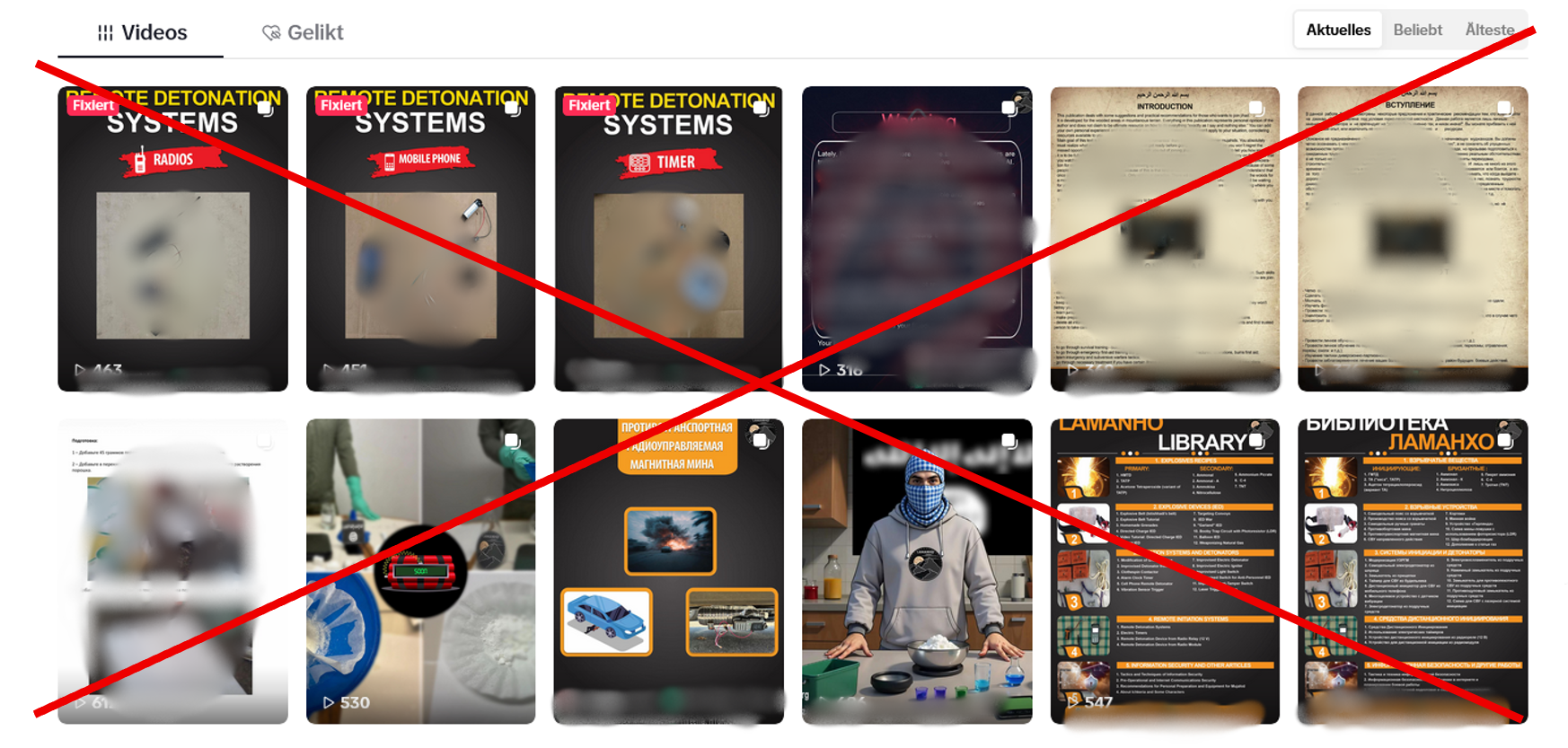
The channels and content of violence-prone actors are organised in a decentralised manner across a multitude of platforms. For example, users are redirected via public links on TikTok or Instagram profiles to channels and groups on Telegram or even to websites. On all platforms, one can observe both accounts belonging to anonymous individuals and channels operating in the name of “official” supporting organisations, such as the so-called “Islamic State”. The content disseminated includes quotes from well-known jihadist ideologues that legitimise violence, propaganda for terrorist groups, and instructions on carrying out attacks and constructing explosive devices.
Within the far-right spectrum, too, there are posts and accounts that seek to legitimise violence in a more or less subtle manner. Threat scenarios are frequently conjured up, and violence is then portrayed as a necessity for supposed (self-)defence. Particularly in comment sections, there are repeated posts, GIFs or memes calling for violence against individuals or groups labelled as “enemies”. In addition, there are various far-right groups, often with very young members, who display a high propensity for violence. These include, for example, groups such as “Neue Deutsche Welle” (NDW) (formerly: “Deutsche Jugend Voran”), “Jung & Stark” (J&S) or “Revolte-Gruppierungen”.
Due to suspicions of violent acts committed by members of NDW and J&S against political opponents and alleged paedophiles (“paedohunting”), the Federal Public Prosecutor’s Office carried out searches in various federal states in May 2026.[2] In this context, the so-called Active Clubs are also proving to be a potential recruitment ground. Modelled on the US example, these are increasingly spreading in Germany and combine combative rhetoric with physical training. On Telegram, there are both Germany-wide accounts and regional offshoots. The example of the Active Clubs illustrates the inseparable fusion of online and offline activities, which now forms the basis for some of these actors.
In addition, there is a growing number of accounts that cannot be clearly assigned to any particular ideological current and which stand out primarily for their positive references to attacks, rampages and the perpetrators responsible. One account, whose name alone expresses anti-Semitic hatred towards Jewish life, serves as an example of just how diffuse and, in some cases, intertwined ideological elements are. The account posts various videos that openly advocate acts of violence or can be interpreted as incitement to commit them. In addition to Jews, the targets of hostility include, for example, women, who are referred to using the misogynistic term “foid”, which originates from the “incel” scene. Similarly, a crowd carrying a rainbow flag is depicted as the target of an attack, which, in this context, must be interpreted as legitimising or inciting violence against the LGBTQIA+ community.
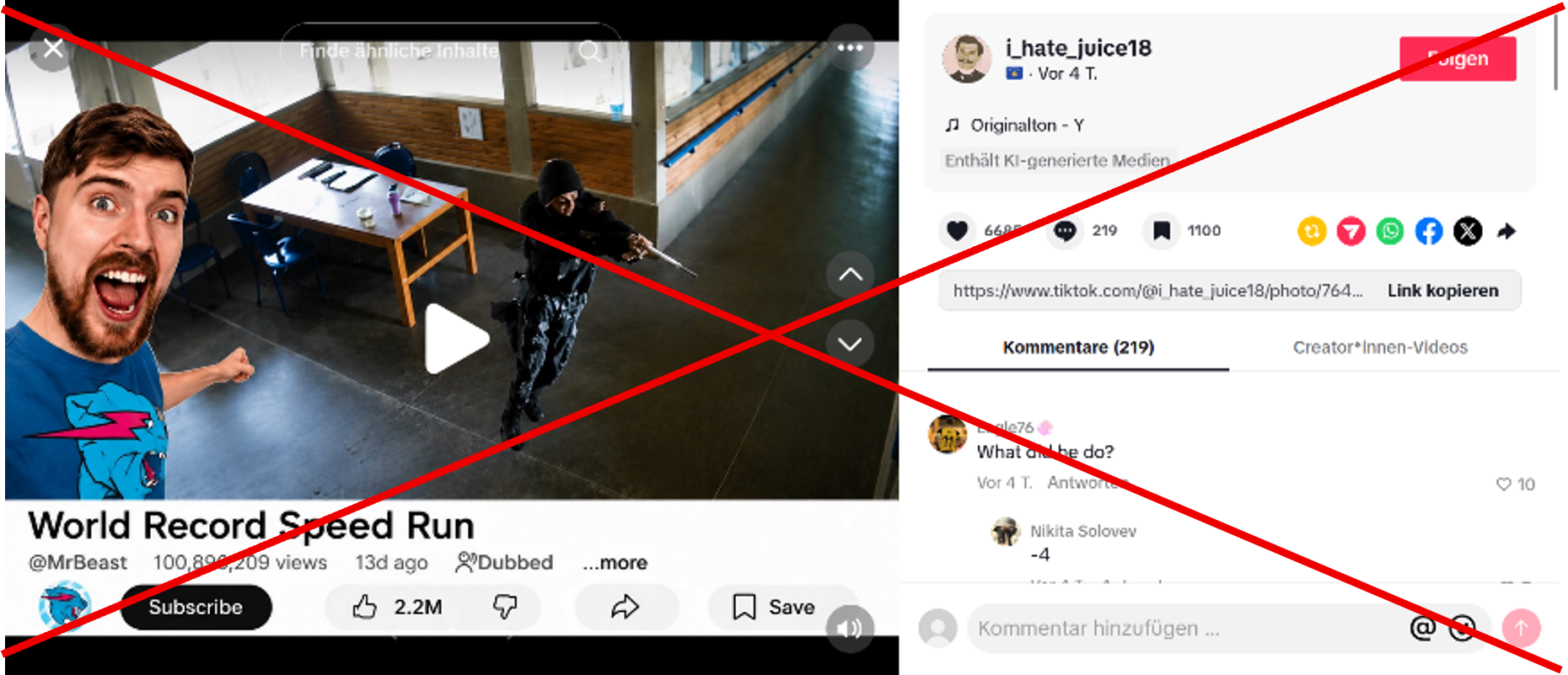
In some cases, these accounts provide indications that they fall within the phenomenon of Nihilistic Violent Extremism (NVE). Actors from this milieu use elements from gaming, anime, memes and pop culture to trivialise their content and thus avoid having it removed. At the same time, the impression is created that these are often very young users who interweave violent content with themes from their own personal lives. The perpetrators mentioned in these posts are openly stylised as heroes in the comments sections through expressions of sympathy and the mockery of the victims. In digital far-right circles, too, it can be observed that coded posts are followed by significantly more explicit comments.
Across all these phenomena, a “gamification” of violent content can be observed. Both in far-right extremism and in the realm of NVE, as well as in fan communities of attackers whose ideological affiliations are not clearly definable, the death tolls from attacks are presented like high scores in a video game. In the video game Roblox, users can create their own content and scenarios – here, one can find recreated and playable attack scenarios, for example from Christchurch, where a far-right extremist attacker killed more than 50 people in two mosques in 2019. In jihadist circles, attack scenarios are also re-enacted in Roblox, as are scenes from well-known “IS” videos, such as executions. Recordings of these scenarios are frequently posted on TikTok.
Jihadist accounts openly call for violence, usually referring to the so-called “Islamic State”. Here, too, there are posts that glorify attackers or slain “IS” leaders as heroes. However, this cult of martyrdom is not a fundamentally new online phenomenon but has been a feature of Islamist groups for decades.
In addition to calls to carry out attacks and use violence – which are often taken from “IS” publications – there are also accounts on mainstream platforms such as TikTok that provide instructions on how to make bombs and carry out attacks. Furthermore, quotes from jihadist preachers that legitimise or call for violence are supplemented with images, videos and audio material to make the content more emotionally charged. In particular, individuals with links to so-called “IS” also use the group’s atrocities to mobilise support, interpreting brutal violence against Shia Muslims, Yazidis and other groups labelled as infidels as proof of their own willingness to act and ideological coherence. This is often accompanied by a call to join the group or to carry out acts of violence in its name.
Channels from the far-right terrorist milieu post structurally comparable content, including on mainstream platforms. In posts by channels from this spectrum, the perpetrators of right-wing terrorist attacks are stylised as heroes and their actions legitimised – often accompanied by calls to take action and carry out attacks themselves. On mainstream platforms, these accounts frequently employ self-censorship and double entendres to prevent their posts and channels from being deleted. On Telegram and other platforms where content moderation is less stringent, more explicit content can be found. Right-wing terrorist groups such as the “Atomwaffen Division” also actively use messaging services for recruitment purposes.
With much of this content, questions arise regarding the credibility of threats of violence and the actual ideological conviction underlying expressions of sympathy for jihadist or right-wing terrorist organisations and individuals. It is conceivable that, particularly amongst younger users, developmental factors such as provocation, a search for identity and a lack of foresight regarding their own posting behaviour also play a role. At the same time, cross-phenomenon cases in recent years make it very clear that (young) people from the milieus mentioned in this article repeatedly take action and commit brutal acts of violence worldwide. The digital spaces in which the perpetrators previously operated appear to have frequently been a relevant factor in the respective radicalisation processes.[3] The mechanisms and processes behind these acts are complex and cannot be explained by the mere existence of violent content on social media alone.
However, the low-threshold availability of such content and its regular consumption can have an impact on mental health and one’s own relationship to violence, particularly amongst young users.[4] The consumption or creation of violent content must therefore always be taken seriously and requires action from those around the individual and any relevant professionals involved. In most cases, the reach of posts relating to violence is smaller than that of more moderate users. Although posts that legitimise or incite violence sometimes reach five- or six-figure view counts, their relevance and potential danger stem primarily from qualitative factors.
The efforts by civil society prevention organisations, security authorities and platform operators to combat the availability of this content resemble a cycle that is still too rarely broken by sustainable success. The hesitant approach taken by platforms such as Telegram also raises doubts as to whether there is a genuine interest in the sustainable moderation of violent content. Over the last 15 years, successes have certainly been observed on the major platforms, particularly with regard to the availability of propaganda from the so-called “IS”. Propaganda content was deleted more quickly, which significantly reduced its overall availability on the platforms. This was also because the perpetrators initially switched to other platforms following the deletions. At the same time, perpetrators are constantly seeking new ways to circumvent the platforms’ automated reporting systems and terms of use.
[1] See: Thilo Mannemann and Miro Dittrich: “Escalation of Violence as a System”, cemas.io, 27 May 2026: https://cemas.io/publikationen/nihilistic-violent-extremism-in-deutschland or dist[ex] monitor: Report for the first quarter of 2026, dist-ex.de, 18 March 2026: https://www.dist-ex.de/publikationen/detail/distex-monitor-bericht-1-quartal-2026 (last accessed: 11 August 2026).
[2] Federal Public Prosecutor’s Office: “Searches carried out at the homes of suspected members of two far-right extremist criminal organisations (‘Jung & Stark’ and ‘Deutsche Jugend Voran’/‘Neue Deutsche Welle’)”, generalbundesanwalt.de, 6 May 2026: https://www.generalbundesanwalt.de/SharedDocs/Pressemitteilungen/DE/2026/Pressemitteilung-vom-06-05-2026.html (last accessed: 11 August 2026).
[3] Peter Neumann: “The New Grey Zone: How Terrorism in Europe Has Changed”, Perspectives on Terrorism, 20(1), March 2026: https://pt.icct.nl/article/new-grey-zone-how-terrorism-europe-has-changed (last accessed: 4 August 2026).
[4] Craig A. Anderson et al.: “Screen Violence and Youth Behaviour”, Pediatrics 140(2), 1 November 2017: https://publications.aap.org/pediatrics/article/140/Supplement_2/S142/34161/Screen-Violence-and-Youth-Behavior?autologincheck=redirected (last accessed: 4 August 2026).

